07 / Learn
AI literacy, plainly.
AI literacy is not learning to code, and it is not learning to prompt. It is being able to judge what a system is doing, what it is likely to get wrong, and whether you should trust its answer.
What the country is doing
The national program
In January 2026 the Department of Education launched Project AGAP.AI, the first nationwide program for responsible AI in basic education. The stated target is 1.5 million students, teachers and parents trained during 2026.
The syllabus covers AI fundamentals, classroom use, ethics, data privacy and the risk of misinformation. Teacher training modules were scheduled for the second quarter of 2026. MIT's Responsible AI for Social Empowerment and Education initiative and the Day of AI program are supporting it, alongside a separate Microsoft Philippines partnership.
Sources: Philippine Information Agency — Marcos launches AI Literacy Program · BusinessWorld — DepEd targets 1.5 million · Microsoft — DepEd partnership
What it means
Four questions that make you literate
Most AI training teaches tools. Tools change every few months. These questions do not — they work on a chatbot, a hiring filter, a loan model or whatever comes next.
- 01
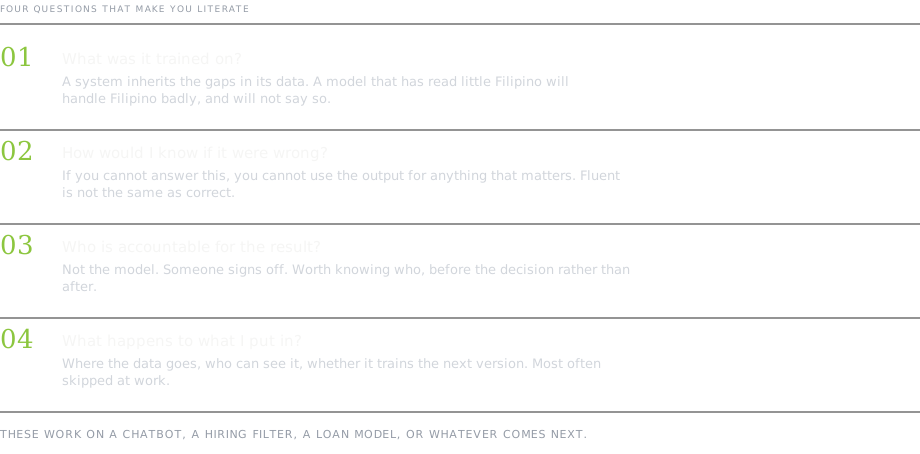
- What was it trained on? A system inherits the gaps in its training data. A model that has read little Filipino will handle Filipino badly, and will not tell you so.
- 02
- How would I know if it were wrong? If you cannot answer this, you cannot use the output for anything that matters. Fluent writing is not evidence of correct writing.
- 03
- Who is accountable for the result? Not the model. Someone signs off on a decision, and it is worth knowing who before the decision is made rather than after.
- 04
- What happens to what I put in? Where the data goes, who can see it, and whether it trains the next version. This is the question most often skipped in workplaces.
Where to start
If you are a teacher, an employer, or curious
Teachers — the DepEd program is the official route and the materials come through your division office. Start there rather than with commercial training.
Employers — the four questions above are a usable internal policy on their own. Most organizations need a decision about what staff may put into a chatbot far more urgently than they need tooling.
Researchers and students — the labs directory lists every institution in the country doing AI research, including which ones say they work with startups.
Nothing is being sold here
This is a free explainer, not a course. The facts about the national program are sourced and linked above. The four questions are our own framing — take them or leave them.