Landscape
What it looks like when you count it.
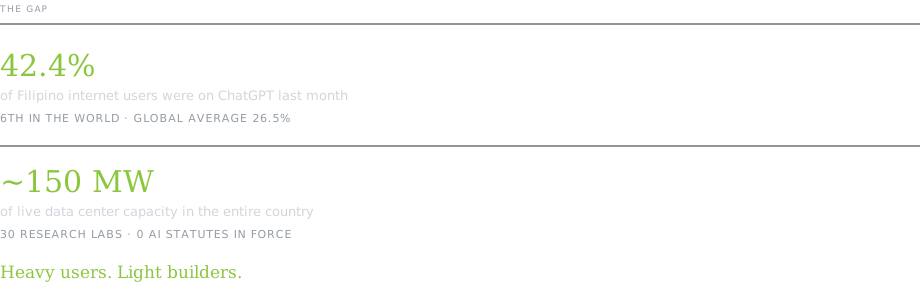
The Philippines is building AI infrastructure faster than it is building AI research capacity. That gap is the most important fact in this directory.
Compiled 29 July 2026
Research capacity
Concentrated, and mostly public
30 laboratories and centers are listed. The distribution matters more than the total:
| Sector | Labs | Share | Startup-friendly |
|---|---|---|---|
| Academic | 15 | 50% | 8 |
| Government | 10 | 33% | 8 |
| Private | 5 | 17% | 4 |
Academic and government bodies account for the overwhelming majority. Only 5 private-sector labs are listed, and several of those are multinational research teams rather than Philippine companies. Research capacity here is a public asset, funded publicly, and it will rise or fall with public budgets.
Compute
Building fast, disclosing little
40 facilities across 17 operators. 33 live, 4 under construction, 3 announced.
Two caveats sit on top of every capacity number published about the Philippines. First, only 14 of 40 facilities disclose an IT capacity figure at all, so any national total is an estimate wearing a precise number. Second, only 11 entries are operator-confirmed — the rest come from aggregators that copy one another.
The single largest item, the announced 3 GW Pax Silica hub, is roughly twenty times the country's entire current live capacity. Treat it as an intention, not a forecast.
People
The one number that is moving
10 AI literacy programs are running, and between them they carry the national target of 1.5 million people trained during 2026. About 796,000 have reportedly completed training — roughly half the goal, and the only large figure in this directory that describes something that has already happened rather than something planned.
It is also the cheapest of the three bets. Training people costs a fraction of a gigawatt of power, and the skill stays in the country regardless of who ends up owning the compute. See every program →
The gap
Adopters, not builders — for now
Put the three sections together and a pattern shows. Capacity is arriving in gigawatts, driven by telcos and foreign developers. Research capacity is measured in a few dozen labs, most of them university departments. Companies number in the handful with traceable sourcing, and the country's pioneering AI firm was acquired.
That is the shape of an economy positioning itself to host and consume AI rather than build it. It is not necessarily the wrong bet — hosting is real revenue and real jobs. But it is a different bet from sovereignty, and the policy documents talk about the second while the capital is going into the first.
What is missing
Where this is incomplete
Lab entries are ageing. Most date from 2022–2025. Labs close, merge and rename without announcing it, so check before citing one.
Company coverage is thin. 14 entries. Companies without a traceable source are not listed, so real firms are missing.
No funding data. Research grants and startup funding are not tracked.
Policy moves fast. 7 instruments listed; at least one is still a draft. Re-check dates before quoting them.