02a / Pax Silica
The three-gigawatt question.
Pax Silica is the biggest thing announced in Philippine technology, and most of what gets repeated about it is wrong in one direction or the other. Here is what is settled, what is genuinely disputed, and what nobody knows yet — in plain English, with a source for every answer.
Updated 29 July 2026 · every answer sourced
Start here
Nothing has been signed. The Philippines has joined the declaration and set aside the land, but the agreement that governs the zone is still a draft, targeted for signing in November 2026. Every figure on this page — the jobs, the billions, the gigawatts — describes a plan, not a thing that exists.
The basics
What it is, in seven lines
| What it is | A planned 1,620-hectare industrial zone inside New Clark City, in Capas and Bamban, Tarlac. |
| Part of | Pax Silica, a United States-led initiative launched December 2025 with 24 country signatories. New Clark City is its first "Golden Node". |
| Main industries | AI hardware manufacturing, semiconductor production, and processing of critical minerals such as nickel and copper. |
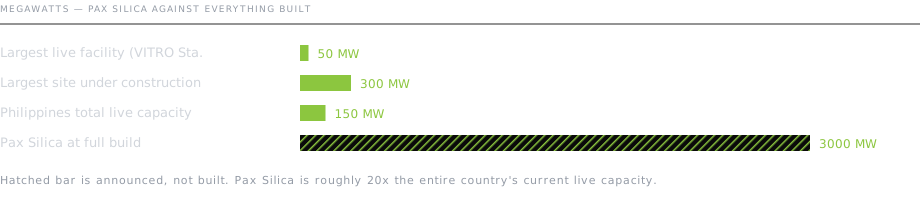
| Power at full build | Up to 3,000 MW (3 GW) for the whole zone — BCDA. |
| Investment | Up to US$70 billion — BCDA estimate. |
| Interest | More than 30 companies have expressed interest — BCDA. |
| Status | NOT signed. The Philippines–US framework is still in draft. The US State Department is targeting a signing in November 2026 at the ASEAN Summit in Manila. |
The questions
What people are actually asking
Every answer is labelled with how solid the evidence is. Where the two sides give different numbers, you get both — not an average that flatters neither.
01 · Common misconception
Is Pax Silica a giant AI data center?
No — and this is the most common mistake in the coverage.
The Department of Trade and Industry says plainly that this is not about building data centers. Undersecretary Ceferino Rodolfo: "Hindi ito tungkol sa pagtatayo ng data center dito sa Pilipinas. Ito ay pag-manufacture ng mga components." The zone is meant to make the parts that go into AI and semiconductor systems, and to process minerals the country currently ships out raw. Data centers may follow, but they are not the plan. Anyone comparing the 3,000 MW figure to a normal data center's size is comparing two different things: 3,000 MW is the power the entire industrial zone would draw at full build, not computing capacity.
Sources: GMA News — What is Pax Silica and why are people worried?
02 · Not signed yet
Is it already a done deal?
No. Nothing has been signed.
The Philippines has joined the Pax Silica Declaration, and BCDA has set aside the land. But the actual arrangement governing the zone is still a draft. The US State Department is aiming to sign it in November 2026 during the ASEAN Summit in Manila. Until then the investment figures, the job numbers and the timelines are projections attached to an unsigned agreement. Treat every number below as a plan, not a result.
Sources: Philstar — framework may be signed by November · BusinessWorld — PHL, US finalize draft
03 · Genuinely disputed
Will 20,000 Aeta and farmers be driven off their land?
The two sides give numbers that are almost impossible to reconcile. This one is genuinely unresolved.
Kalikasan, an environmental network, says as many as 20,000 Aeta and farmers could be displaced. Its national coordinator Cathleen De Guzman has repeated the figure publicly. BCDA president Joshua Bingcang flatly denies it: the site is titled public land, he says, with no ancestral domain title over it, it was already marked buildable in the New Clark City master plan long before this project, and roughly 10 farmers are directly affected. He has offered livelihood support and urban farming for them. Both numbers cannot be right. They are also not measuring the same thing — one counts people directly on the 1,620 hectares, the other counts a wider area and knock-on effects. Neither side has published the working. Until someone does, this is the biggest open question about the project, and you should be suspicious of anyone stating either figure as settled fact.
Sources: DZRH — BCDA assures no farmers will be displaced · GMA News explainer · Manila Times — scientists, environmentalists, farmers hit the hub
04 · Open question
Will it drink the water supply dry?
The demand is real and large. Whether it hurts local supply depends on a design that is not built yet.
Estimated water use runs 65 to 90 million liters a day. For scale, a single chip factory can use around 37.8 million liters of ultra-pure water daily, and some AI facilities abroad use up to 5 million gallons — about 18.9 million liters — a day for cooling. BCDA's answer is that the zone will not take groundwater: it plans rainwater harvesting with impounding facilities, partly because water tables in parts of Central Luzon are already falling, and says surplus could be shared with nearby communities. The National Water Resources Board has said local sources are sufficient and that household supply stays the priority. Kalikasan's response is the fair one: assurances are not data, and the studies should be published. The honest position is that the plan is reasonable on paper and unproven in practice.
Sources: GMA News — How would Pax Silica sustain its water demand? · BusinessMirror — water board says local source enough
05 · Unproven both ways
Will my electricity bill go up?
Nobody has shown the arithmetic either way. This is the concern with the weakest public evidence on both sides.
The Makabayan bloc warns Pax Silica "threatens to permanently lock the Philippines into having the highest power rates not just in Southeast Asia but in all of Asia." That is a serious claim and it has not been published with a model behind it. BCDA's counter is that the zone gets a dedicated green energy grid built for it, running mainly on solar, with a 500 MW solar project with Saudi Arabia's ACWA Power already underway at New Clark City — meaning it would not simply draw from the existing grid households use. Neither side has released the load study that would settle it. What is true regardless: 3,000 MW is a very large amount of power for one zone, and where it ultimately comes from has not been finalized.
Sources: Inquirer — Makabayan warns of higher power costs · Maharlika — BCDA to build dedicated green grid · GMA News — 3 GW at full development
06 · A projection
Are the 200,000 jobs real?
Treat it as a projection for a zone that does not exist yet.
BCDA forecasts up to 200,000 jobs and as much as ₱180 billion a year in government revenue. An agricultural workers' group has challenged the figure — not by disputing the arithmetic but by pointing out that nobody has said what kind of jobs these are, at what pay, or how many go to people already living in Tarlac rather than to workers brought in. That is the right question. A job number with no breakdown by skill level, wage and hiring source is a headline, not a commitment. The figure also assumes an unsigned agreement, full build-out, and 30-plus interested companies actually investing.
Sources: Inquirer — agri workers' group warns on land and labor · BusinessWorld — BCDA pegs investment at up to $70B
07 · True, with nuance
Is the government giving away the land for free?
Not free — but rent-free for two years, and the rent after that has not been set.
BCDA is giving a two-year grace period on lease payments, described in its own announcement as "an unconditional in-kind contribution" to the economic cooperation between the two countries. The annual lease rate from the third year onwards "will be determined separately under a subsequent agreement" — meaning it does not exist yet. DTI says a grace period is standard for large land developments, which is fair. The part worth watching is not the two free years; it is that the rent for years three onward is still unwritten on 1,620 hectares of public land.
Sources: BCDA — official announcement · GMA News explainer
08 · A judgement call
Who benefits — the Philippines, or the United States?
Both, by design. Whether the split is fair is a political question, not a factual one.
The stated Philippine gain is that critical minerals get processed here instead of being shipped out raw, so the value added stays in the country — DTI's Ceferino Rodolfo has made that the central argument. The stated US gain is supply-chain security: a trusted place outside China to make chips and process minerals. US Undersecretary Jacob Helberg calls the Golden Node a hub "anchored in the rule of law, and integrated into a network of trusted nations." Both things can be true at once. Scientists including Dr. Giovanni Tapang of the UP College of Science argue the balance falls the wrong way — that the project drains local resources without real returns for Filipinos. That is a judgement about terms that have not been published yet, which is precisely why the unsigned lease and the unreleased studies matter.
Sources: BCDA — official announcement · PIA — BCDA eyes AI industrial hub under US-led initiative · Manila Times — scientists hit the AI hub
09 · What to watch
What should I actually watch for?
Four documents. If they appear, the arguments stop being guesswork.
One: the signed framework, expected November 2026 — until then everything is a proposal. Two: the lease agreement, especially the rent from year three. Three: the Environmental Compliance Certificate and the studies behind it, which is where the water and power questions get answered with numbers instead of assurances. Four: a jobs breakdown by skill level, wage and hiring source. BCDA says project documents are posted on the Board of Investments website. Every one of these is a public document in principle. Ask for them by name.
Sources: GMA News explainer
The missing evidence
What nobody has published
Neither displacement figure shows its working. Kalikasan says 20,000. BCDA says 10. Neither has explained how it counted. Until one of them does, nobody can settle this.
No power or water study is public. Both sides are arguing from assertion. The Environmental Compliance Certificate process should produce real figures. They are not out yet.
Almost nobody is talking about it online. There is very little public discussion of Pax Silica on forums or social platforms. For a project this large, that is worth noticing: the argument is running between agencies, advocacy groups and newsrooms — not among the people who live next to it.
Have one of these documents? Send it and it goes up here, credited.
Related
All 40 Philippine data centers →
The policy instruments behind the AI push →
How to judge an AI claim yourself →