06 / Usage
Filipinos adopted AI first.
The Philippines built almost none of this technology and has barely any of the compute. It is still one of the heaviest users of it on earth. These are the numbers, and where they came from.
Updated 29 July 2026 · every figure sourced
ChatGPT use, by country
Sixth in the world.
Share of internet users aged 16 and above who used ChatGPT in the previous month. Surveyed by GWI in the second quarter of 2025 and published in the Digital 2026 report.
| Country | Share of internet users | |
|---|---|---|
| Kenya | 49.5% | |
| Brazil | 49.1% | |
| Israel | 49% | |
| Malaysia | 48.4% | |
| United Arab Emirates | 44.7% | |
| Philippines | 42.4% | |
| Global averagebenchmark | 26.5% |
People
Filipinos use AI more than almost anyone
This is the single most striking fact about AI in the Philippines, and it has nothing to do with infrastructure or policy. Ordinary Filipinos adopted it faster than nearly every other country on earth.
The Philippines sits sixth globally, behind Kenya, Brazil, Israel, Malaysia and the United Arab Emirates. Filipino usage runs at roughly 1.6 times the world average. That is a country adopting a technology far faster than it is building the infrastructure underneath it — which is the central tension in this whole directory.
Sources: Daily Tribune — Philippines 6th in global AI adoption · PhilSTAR Life — Pinoys among top ChatGPT users
The base
Nearly everyone is already online
AI adoption did not happen in a vacuum. It landed on one of the most connected populations in Southeast Asia.
Facebook reaches 95.8 million users here, TikTok 64 million, YouTube 59.6 million. Median mobile download speed hit 59.6 Mbps, up 77 percent in a year; fixed broadband averages 105.2 Mbps. The pipes and the phones were already in place, which is why a chatbot could reach four in ten internet users without any national rollout at all.
Sources: DataReportal — Digital 2026: The Philippines · Marketing-Interactive — 98 million internet users
Work
The BPO question, and why the numbers disagree
Business process outsourcing is the country's second-largest dollar earner. How much of it AI takes is the most consequential unanswered question in the Philippine economy — and the published estimates are wildly far apart.
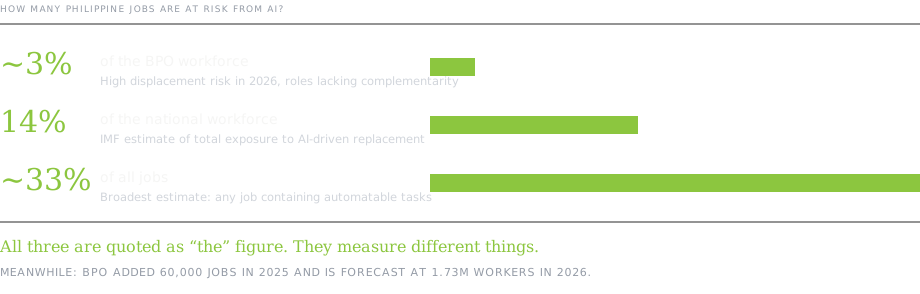
Three different credible-sounding figures circulate for how many Philippine jobs AI puts at risk: about 3 percent of the BPO workforce at high risk in 2026, 14 percent of the total national workforce per the IMF, and roughly one-third of all jobs in the broadest estimates. They are not measuring the same thing — one counts near-term high-risk BPO roles, another counts national exposure, the third counts any job with automatable tasks. Anyone quoting a single figure without saying which definition they used is not telling you much. What is measurable so far points the other way: the sector added more than 60,000 jobs in 2025 and is forecast to reach 1.73 million workers in 2026.
Sources: Philstar — BPO grows 4% to 1.68M despite AI fears · IMF — AI and the Philippine labor market (PDF) · Manila Times — the AI reckoning
What it adds up to
Heavy users, light builders.
Four in ten Filipino internet users are on ChatGPT. The country has 30 AI research labs, roughly 150 MW of live data centre capacity, and no AI statute in force. The gap between how much Filipinos use AI and how much the Philippines makes is the widest of any figure in this directory.
That is not automatically bad — being an early, skilled user of a technology is worth real money, and the BPO sector is proving it by growing while adopting AI. But it does mean the terms get set elsewhere, which is exactly why the policy and infrastructure questions matter.